
Research
I study the physics of soft and disordered materials—glassy liquids, amorphous solids, polymers, and dense active matter—using large-scale computer simulations and analytical theory, often in close collaboration with experimental groups. Across these domains, my work focuses on how structural disorder, self-propulsion, and external mechanical or thermal driving dictate macroscopic transport, relaxation, and failure modes in complex material systems.
Dense Active Matter: Jamming, Fluidization, and Avalanches
I examine how dense active materials—comprising self-propelled units—undergo transitions between jammed, solid-like states and flowing, fluidized states. In athermal active glasses, I investigate how microscopic activity destabilizes amorphous solids, how thermal and mechanical processing histories dictate the fluidization threshold, and how collective particle rearrangements organize into spatio-temporal avalanches near yielding. A central objective is to establish a unified statistical mechanics framework connecting activity-induced fluidization with shear-induced yielding in passive glassy solids via dynamic heterogeneity signatures.
Related Publications:
- V. Vaibhav et al., Jamming-to-Fluidization Transition in Dense Athermal Active Matter (in preparation, 2026).
- V. Vaibhav et al., Avalanches in Dense Active Matter (in preparation, 2026).
- V. Vaibhav et al., Dynamic Heterogeneity in Active Liquids (in preparation, 2026).
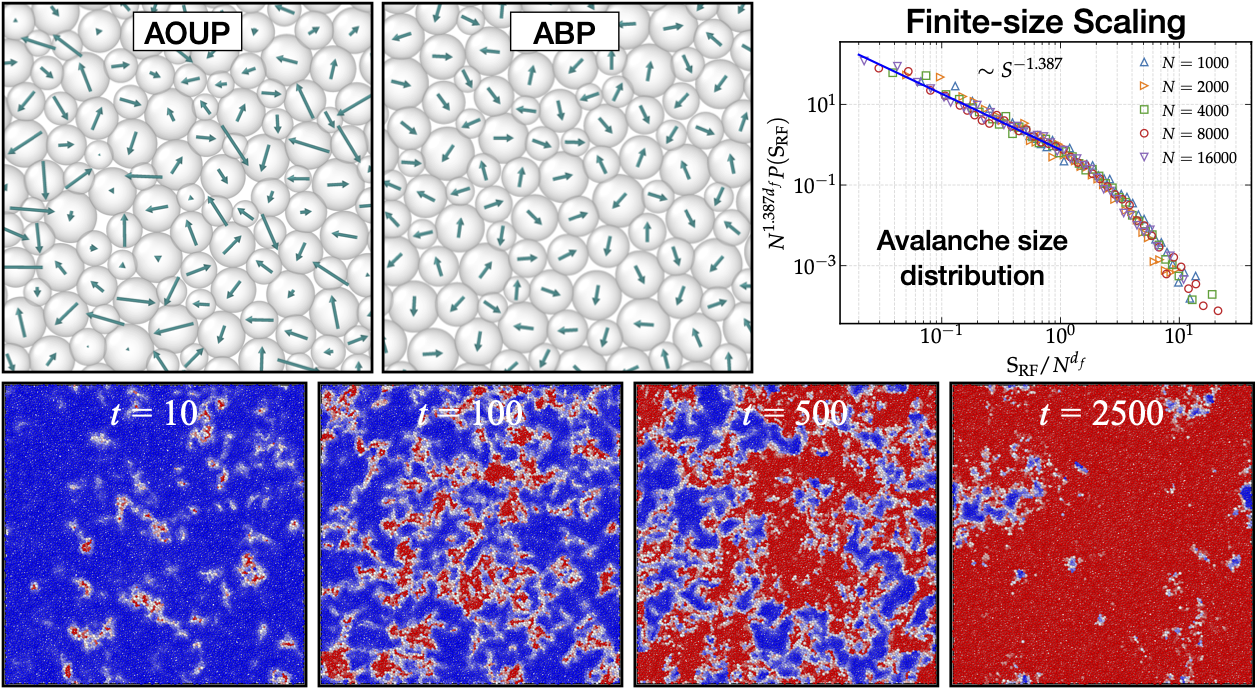
Figure 1: Dense Active Matter Dynamics. Microscopic propulsion force configurations comparing Active Ornstein-Uhlenbeck (AOUP) and Active Brownian Particle (ABP) models. Finite-size scaling collapse of active rearrangement region sizes $S_{\text{RF}}$, demonstrating power-law kinetics. Spatiotemporal evolution of activity-induced fluidization from localized rearrangements in a jammed matrix (blue) to bulk flowing states (red).
Polymer Viscoelasticity from Non-Affine Lattice Dynamics
In collaboration with experimental and industrial research partners, I link atomistic chemical structures directly to macroscopic viscoelastic properties. Utilizing Non-Affine Lattice Dynamics (NALD), we calculate frequency-dependent dynamic shear moduli ($G’, G’’$) and viscosity across more than twenty frequency decades—spanning high-frequency molecular vibrations down to quasi-static mechanical response. This scale-bridging theoretical framework enables direct interpretation of experimental spectra for epoxy thermosets and amorphous polymers without relying on phenomenological fit parameters.
Related Publications:
- V. Vaibhav, T. W. Sirk, and A. Zaccone, Macromolecules 57, 10885 (2024).
- A. Singh, V. Vaibhav, T. W. Sirk, and A. Zaccone, J. Chem. Phys. 162, 244504 (2025).
- A. Singh, V. Vaibhav, T. W. Sirk, and A. Zaccone, Atomistic Framework for Glassy Polymer Viscoelasticity Across Twenty Frequency Decades, arXiv:2511.18406 (2026).
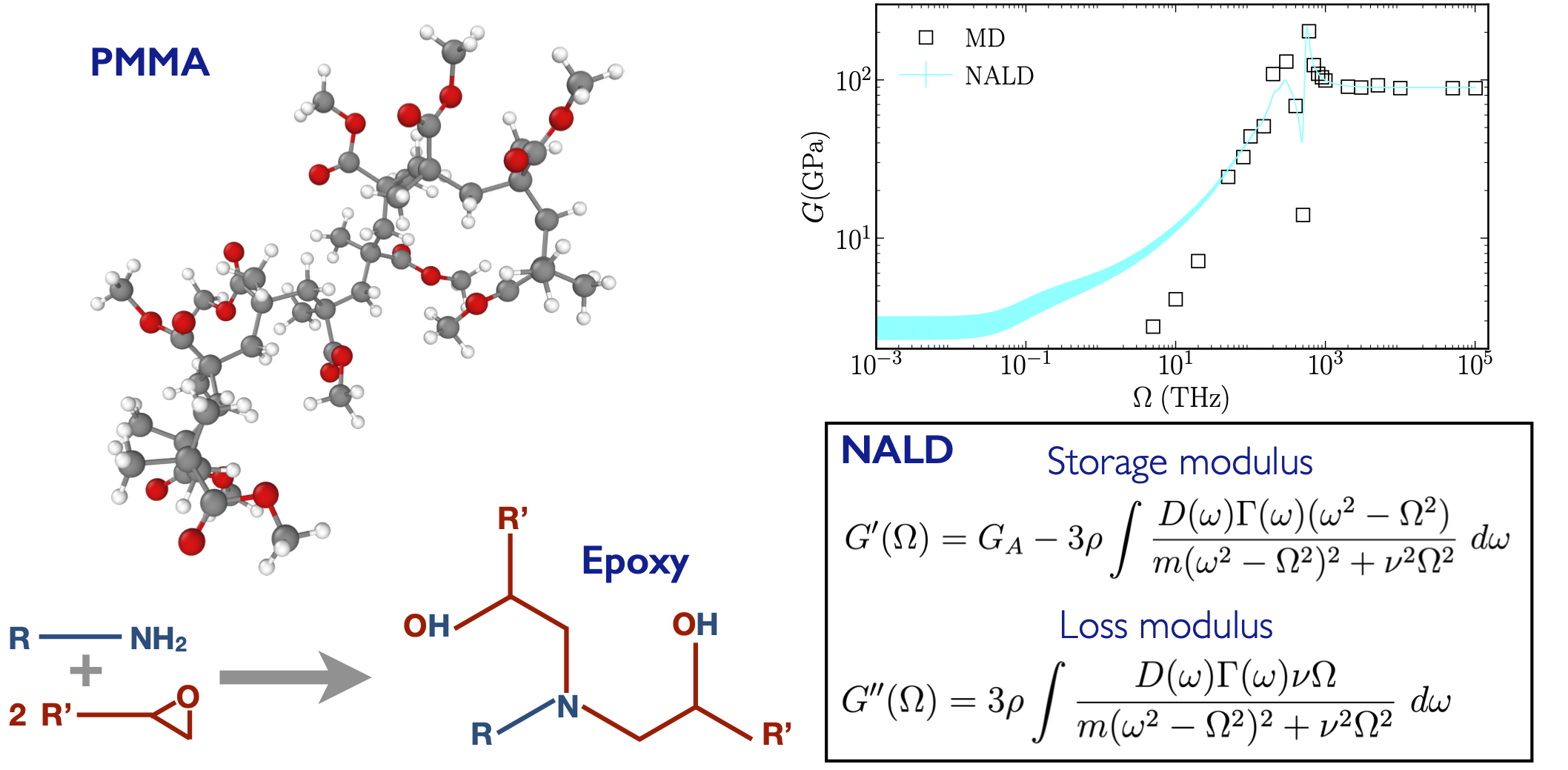
Figure 2: Non-Affine Lattice Dynamics (NALD) of Polymers. Multiscale link between chemical structure (PMMA/Epoxy) and spectrum-wide viscoelasticity. Analytical formulations for complex viscoelastic modulus $G$ (also storage $G'$ and loss $G''$ moduli) capture molecular dissipation features across many decades of frequency ($\Omega$).
Thermal Response of Glassy Systems
I study how glass-forming systems respond to steady-state temperature gradients and localized thermal perturbations. In binary Lennard-Jones glasses, I demonstrated that heat and mass transport strongly decouple in the supercooled regime, inducing composition gradients via thermal diffusion (the Soret effect, $S_T$). In ultrastable polydisperse glasses, I model front propagation during local heat melting to determine when melting occurs via planar interface propagation versus volumetric thermal breakdown.
Related Publications:
- V. Vaibhav, J. Horbach, and P. Chaudhuri, Phys. Rev. E 101, 022605 (2020).
- V. Vaibhav, J. Horbach, and P. Chaudhuri, Front Propagation During Melting of Glass via Local Heating (in preparation, 2026).
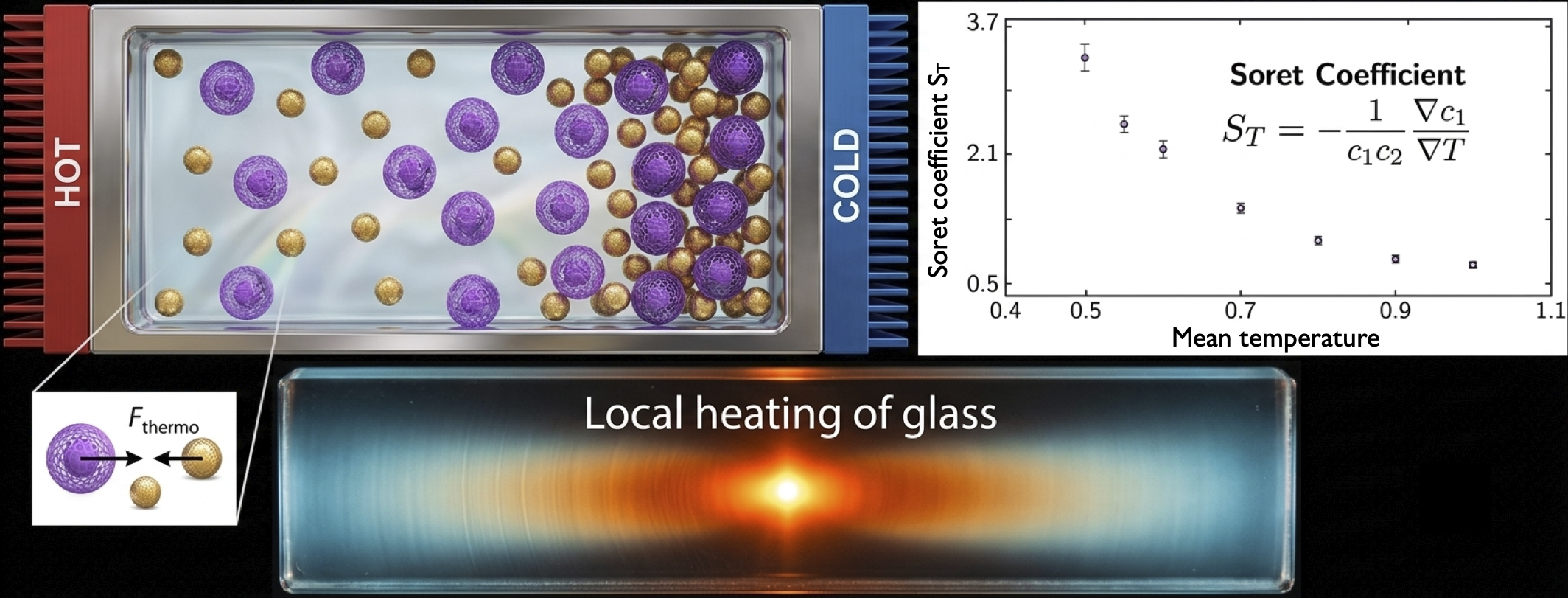
Figure 3: Thermal Response and Non-Equilibrium Transport. Soret coefficient $S_T$ temperature dependence in binary mixtures under imposed thermal gradients and localized thermal melting response.
Rheology and Failure of Glassy and Complex Liquids
My research addresses the physics of mechanical deformation, flow localization, and structural failure in disordered solids and complex fluids. In size-polydisperse systems, I identified a dynamic partitioning mechanism where a rigid matrix of large particles coexists with mobile small particles to govern bulk viscosity. In confined Poiseuille flows, I quantified how stress gradients and boundary walls modify local viscosity profiles relative to bulk shear. Recent work uses targeted spatial heterogeneity to direct shear band nucleation and control macroscopic failure pathways in glassy solids.
Related Publications:
- V. Vaibhav and P. Chaudhuri, Phys. Fluids 33, 053103 (2021).
- V. Vaibhav, J. Horbach, and P. Chaudhuri, Soft Matter 18, 4427–4436 (2022).
- V. Vaibhav, J. Horbach, and P. Chaudhuri, Phys. Rev. Materials 7, 095601 (2023).
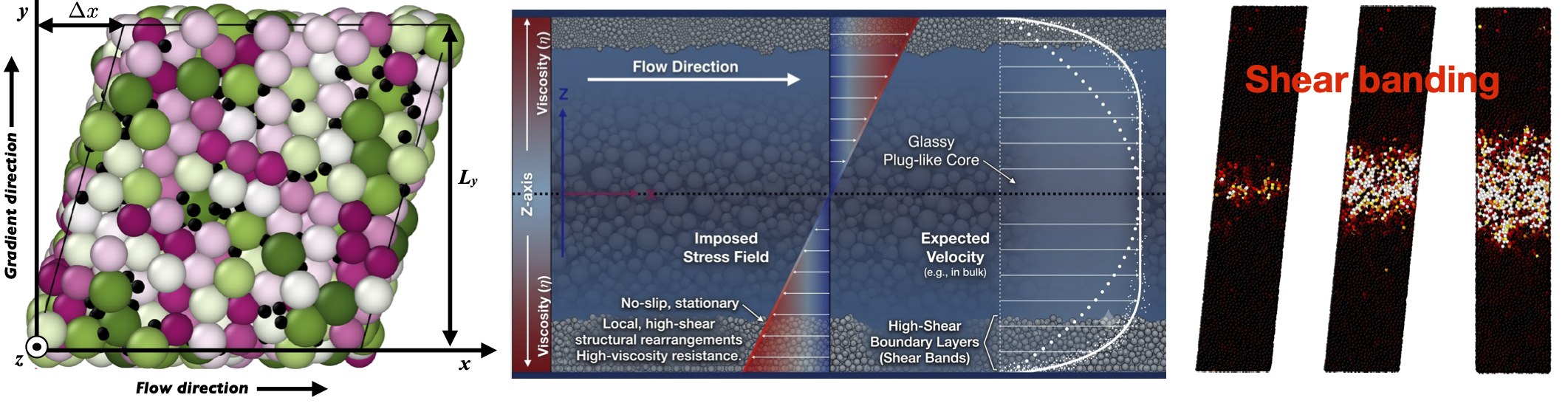
Figure 4: Amorphous Rheology and Shear Banding. Shear deformation, non-uniform velocity/stress profiles in Poiseuille flow, and emergent shear-banding failure pathways.
Supercooled Glassy Liquids and Dynamic Heterogeneity
I analyze relaxation dynamics and dynamic heterogeneity near the glass transition across varying interaction potentials, densities, and temperatures. In disparate-size particle mixtures, I demonstrated that removing global center-of-mass drift isolates genuine spatial localization signatures from collective motion. Using information-theoretic metrics (such as negentropy of displacement distributions $G_s(x,t)$), we define entropic timescales that characterize non-Gaussian, intermittent transport in supercooled states. In soft-sphere systems, I investigate thermodynamic density scaling to establish universal crossover markers across the phase diagram.
Related Publications:
- V. Vaibhav, J. Horbach, and P. Chaudhuri, J. Chem. Phys. 156, 244501 (2022).
- V. Vaibhav and S. Dutta, Phys. Rev. E 109, L062102 (2024).
- V. Vaibhav, T. Das, and S. Dutta, Annalen der Physik 538 (4), e00247 (2026).
- A. Singh, V. Vaibhav, S. L. Singh, and Y. Singh, Glassy Dynamics, Crossover Temperature and Density Scaling in Fragile Glass-formers (in preparation).
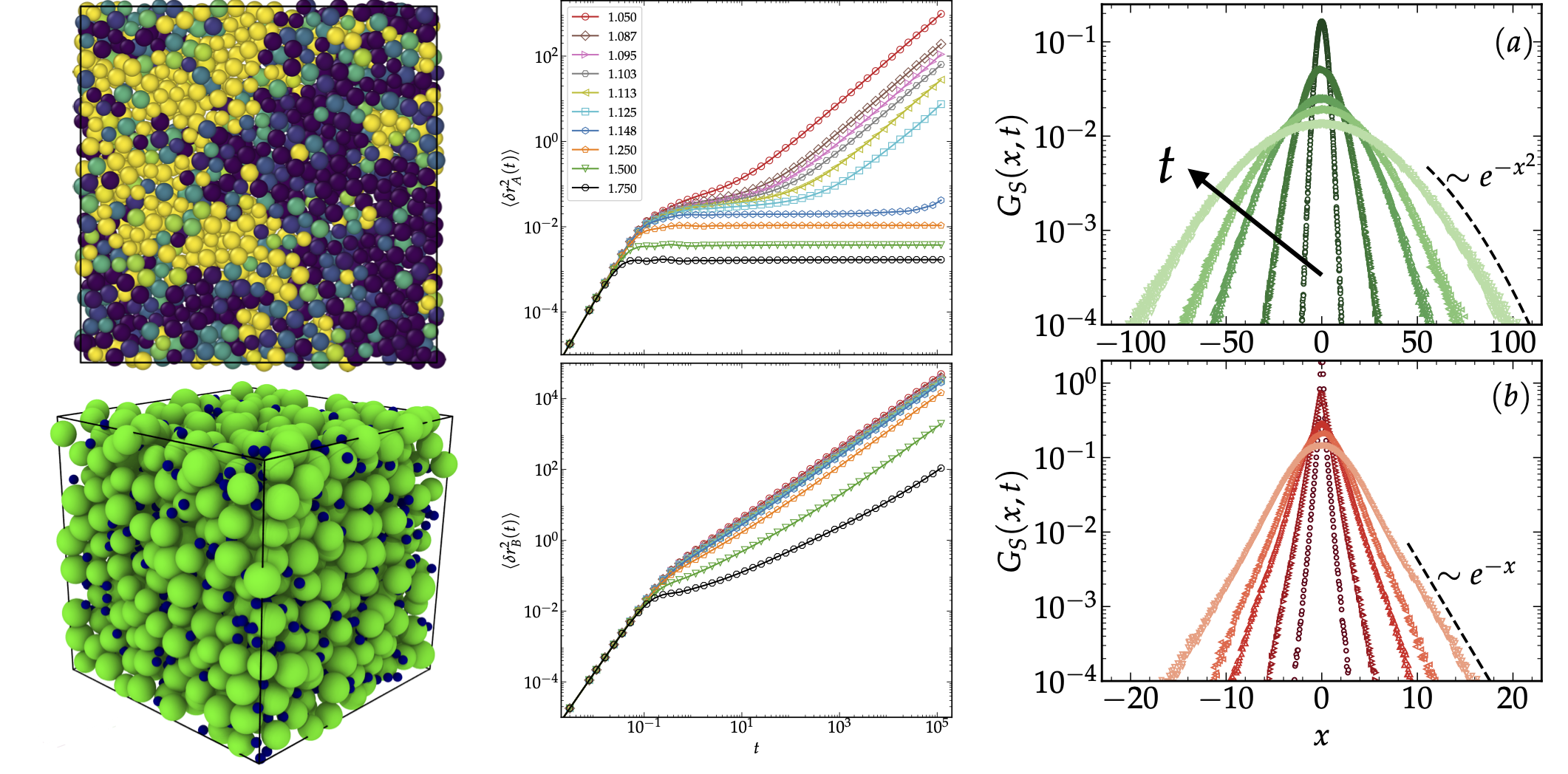
Figure 5: Dynamics in Supercooled Liquids. Mean squared displacements and self-part of the van Hove distribution function $G_s(x,t)$, highlighting non-Gaussian exponential tails that mark intermittent, heterogeneous structural relaxation.